


Investment Strategies for Conservation: One Large Area vs. Many Small Areas
- Feb 12
- 5 min read
Updated: Feb 17
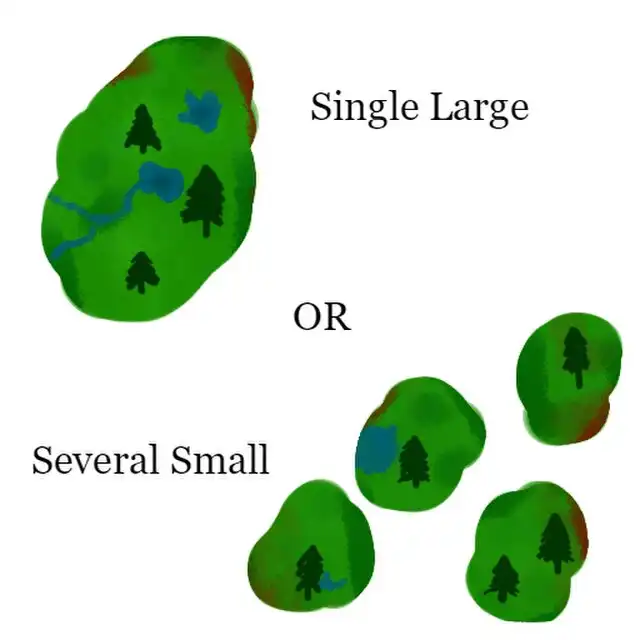
The Single Large or Several Small debates (SLOSS) demonstrate a widely known concept within conservation biology. SLOSS highlights the ongoing argument of the best way to organize protected areas to conserve biodiversity. With the intent to limit species extinction rates, is the course of action establishing a single large and extensive nature reserve or a variety of smaller reserves with equal area? The main principle that supports this debate is the idea of habitat fragmentation and island biographic theory. Within this blog, we will highlight relevant experiments to showcase and analyze this debate further.
Why This Matters
Provides Research for Mitigating Biodiversity Loss: This debate demonstrates clear motivations for conservation efforts while providing research for the best method of preservation, getting the world one step closer to effectively mitigating climate change.
Contributes Significantly to Sustainable Development: The goal of conservation is to establish a system in which humans can preserve nature and biodiversity for future.
Limits Overexploitation and Extinction: Overexploitation of nature results in increased extinction rates, the SLOSS debate works to combat harm caused from this issue by establishing the best form of nature conservation.
Ease the Impact of Invasive Species: Conservation is important because it protects the environment from invasive species that damage resources and result in loss of biodiversity.
What is SLOSS?
The SLOSS debate originated from the study of island biogeography which examined the distribution of plants and animals on islands of varying sizes. In 1975 Jared Diamond, following Daniel Simberloff ‘s response to MacArthur and Wilson's island equilibrium theory proposed several design principles to conservation. This idea continues to spark debate amongst conservation experts.
The argument originated with the intent to establish a method for the design of wildlife sanctuaries and conservation efforts. It acts as a tool to highlight the percentage of extinction as a response to wildlife fragmentation. However, both habitat fragmentation and island biogeography demonstrate the ecological ideas behind this nature conversation.
What is Habitat Fragmentation and Island Biogeography?
These two core ideas of SLOSS demonstrate key ideas behind the formation of SLOSS and research behind the debate. Habitat fragmentation occurs when large habitats made up of a variety of biodiversity are divided into small patches of land due to urban development projects and new roads or infrastructure. As a result, biodiversity can become threatened. However, experts on this debate state that habitat fragmentation may be helpful for conservation efforts when established in the right way. There are some benefits of several small or fragmentation, such as the lack of predators or natural competition that contributes to extinction.
Example: Los Angeles County Island Biogeography
Island Biogeography is a theory that states the size of the island and the diversity within species on the island are positively related. In addition, the size and diversity are negatively related when looking at the distance of the island to the mainland. The extinction and immigration rate of species display two concepts that the number of species is dependent on. Both the extinction rate and immigration rate are influenced by the area and the distance to the mainland.
Below, a project on the construction of a wildlife crossing that spans Highway 101 in Los Angeles County that is supported by the National Wildlife Federation (NWF). The project demonstrates ways to alleviate harmful fragmentation and supports both Single Large and Several Small through habitat connectivity efforts.

Example: Biological Dynamics of Forest Fragments Project
Now that we’ve highlighted a project associated with the ideas of SLOSS, one of the longest projects to evaluate how humans impact the Amazon is known as the Biological Dynamics of Forest Fragments Project (BDFFP). This project operated through a collaboration with the Instituto Nacional de Pesquisas da Amazônia and the Smithsonian Institution. In relation to the SLOSS debate, this project analyzed the habitat fragmentation process occurring in the Amazon basin.

During the BDFFP project, researchers attempted to figure out the number of species that may be able to survive in a particularly sized forest reserve. One, ten, and one hundred hectares of flora and fauna were censused by scientists prior to being isolated from the rest of the Forest. From this study, it was clear that species face extinction in isolation. In terms of the SLOSS debate, this could help back up the Single Large Theory. Additionally, the behavior of species during studies like this can communicate with the best methods of conservation.
BDFFP researchers attempted to quantify how many species could survive in a forest reserve of a given size. Scientists censused the flora and fauna of a series of 12 forest plots of 1, 10 and 100 hectares before they were isolated from the surrounding forest by clear-cutting, and subsequently monitored physical and ecological changes in the reserves after isolation. These studies demonstrated that certain species go extinct in forest isolates. Working in "control areas" of undisturbed forest, BDFFP researchers are trying to identify the factors that lead some taxa to extinction and permit other, often closely related, species to survive
Example: Bird Responses and Variable Logging in Australia
This experiment took place in the Mountain Ash Forest in Toolangi, Marysville as well as Powelltown districts of the Central Highlands of Victoria, Australia. The experiment was divided into seven blocks of homogenous forests. Each block had for harvest units that were allocated to one of four treatments:
Conventional clear-felling where there was no retention of forest.
Variable Retention Harvest System (VRHS) with a 1x1.5 ha island retained.
Variable Retention Harvest System VRHS) with 3 × 0.5 ha islands retained.
Unlogged Control.

The islands were circular in shape, and the blocks resulted in 21 harvest units and seven controls that were unlogged. The experiment found that places that didn’t experience logging had the most species of birds, blocks with Variable Retention Harvest System had less, and blocks with clear-felling had the least amount. The ability for birds to nest and forage creates results in species richness. This study showcases how VRHS has positive impacts on bird species in Mountain Ash forests. VRHS has been used to strengthen biodiversity conservation, aiming to analyze how many patches of forests should be within logged areas, flowing directly into the SLOSS debate.
Take Action
Investors: Understand the SLOSS debate and develop profitable flexible and scalable funding mechanisms accordingly.
Governments: Research this debate to gain a better understanding of the best form of conservation efforts and as a guidance for policies.
Scientists and researchers: Work with regional or national conservation and environmental organizations to participate in active projects that help establish the best course of action.
Multilateral Agencies: Cultivate global incentives and knowledge regarding conservation techniques and incorporate these into long-term goals or projects (i.e. SDGs, etc.).
Policy makers: Advocate for and work alongside urban developers that want to tackle fragmentation and establish connectivity amongst different habitats.


Comments