


One Manual To Rule Them All: Article 6.2 Clarifies Global Carbon Market
- Dec 5, 2025
- 5 min read
COP30 marked an important step for carbon markets as Singapore, Gold Standard, and Verra launched the Article 6.2 Crediting Protocol, facilitating governments to use voluntary standards for compliance. The concept for the Protocol was first announced by NCCS, Gold Standard, and Verra at COP28 in Dubai in December 2023. At COP29 in Baku in November 2024, initial recommendations were published to outline key concepts and processes. Together, these developments paved the way for the finalized Protocol released in 2025.

The Protocol aims to resolve persistent fragmentation across global carbon markets by establishing a unified “operating manual” for cross-border mitigation transfers. This blog explores what exactly is being aligned under the new Protocol, how its core mechanisms work in practice, and what this means for the future architecture of global carbon market integration.
Why This Matters
Parties use differing Nationally Determined Contribution (NDC) accounting approaches, meaning the same mitigation outcome can be reflected differently across national inventories, making reconciliation difficult.
Independent Crediting Programmes (ICPs) operate with their own methodologies, verification procedures, and labelling rules, resulting in limited interoperability across programmes.
The distinction between Carbon Credits and Internationally Transferred Mitigation Outcomes (ITMOs) is often blurred in practice, creating risks of double counting across the credit-transaction layer and the ITMO-accounting layer.
Cross-border transactions rely on non-standardized documentation, authorization requirements, and reporting formats, forcing project developers to repeatedly adapt to different national procedures.
Registries are not interoperable, causing information misalignment and delayed status updates, which undermine transparency and market confidence.
Article 6.2 Coverage
The Protocol aligns three key areas:
Concept: Establishing a Shared Understanding of Mitigation Units
Process: Standardizing the Operational Workflow Across Parties, ICPs, and Project Developers
Roles & Responsibilities: Clarifying Who Does What Across the System
Concept: Establishing a Shared Understanding of Mitigation Units
Alignment of concepts begins with the differentiation between Carbon Credits and ITMOs. Carbon Credits are defined as transferable mitigation units issued by ICPs, each carrying a unique identifier for market transactions. In contrast, ITMOs are defined as accounting units used by Parties for their NDC reporting and must be formally authorized by the host Party and subject to a corresponding adjustment. Through this distinction, the Protocol separates the transaction layer, where Carbon Credits are tracked within project-level registries, from the accounting layer, where ITMOs are recorded within national systems. By creating explicit mapping between these layers, the Protocol strengthens traceability and prevents double counting.
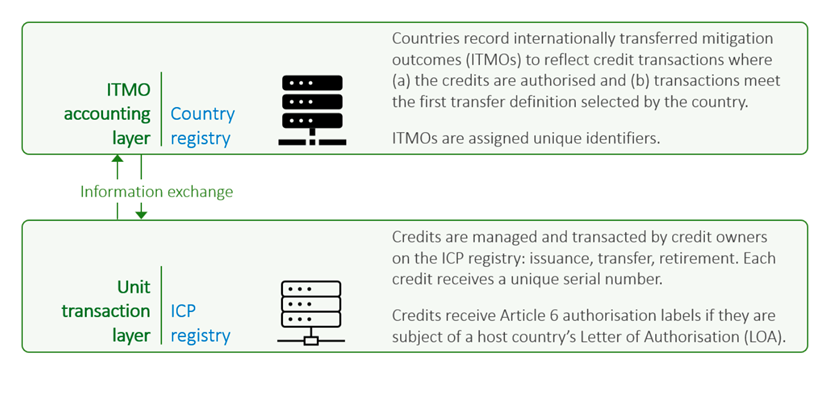
Process: Standardizing the Operational Workflow Across Parties, ICPs, and Project Developers
At the process level, the Protocol standardizes the entire operational workflow by introducing a series of unified procedures that structure how mitigation outcomes move from authorization to reporting. To ensure coherence across different jurisdictions and programmes, the Protocol defines several core operational steps:
Authorization: Parties use a standardized United Nations Framework Convention on Climate Change (UNFCCC) Letter of Authorization (LOA) template to specify the authorized entity, purpose, and unique identifiers, replacing divergent national formats.
First transfer: The “first transfer” marks the moment when the host Party becomes formally obligated to apply a corresponding adjustment, because the mitigation outcome can no longer count toward its own NDC. It must then report the first transfer in its Annual Information and include the corresponding adjustment in its next Biennial Transparency Report (BTR).
Labelling: ICPs apply a consistent Article 6.2 labelling system to ensure clarity and transparency across registries.

Use: Carbon Credits may be applied toward NDCs, Carbon Offsetting and Reduction Scheme for International Aviation (CORSIA), or other voluntary purposes, with their labelling status aligned with corresponding accounting treatment.
Reporting: The Protocol aligns reporting timelines by requiring ICPs to submit annual information by 15 February, giving Parties sufficient time to prepare their Article 6 submissions to the UNFCCC by 15 April. It also mandates standardized, machine-readable reporting formats to minimize inconsistencies and lower coordination costs.
Roles & Responsibilities: Clarifying Who Does What Across the System
To ensure that the Protocol functions smoothly, it clearly delineates the responsibilities of each stakeholder group. By specifying who is accountable for which tasks, the system minimizes inconsistencies and enhances coordination across Parties, ICPs, and project developers. The key roles are as follows:
Parties: Issue authorizations, define cooperative approaches, apply corresponding adjustments in NDC accounting, and submit BTRs to UNFCCC.
ICPs: Manage methodologies, verification, registry operations, Article 6.2 labelling, and check whether Parties’ corresponding adjustments are complete and accurate.
Project Developers: Implement mitigation activities and submit standardized project documentation.
Focal Points: Parties and ICPs designate focal points responsible for resolving data inconsistencies, such as mismatched registry status or reporting information, ensuring alignment between unit tracking and ITMO accounting.
How Does the Article 6.2 Mechanism Actually Work in Practice?
The implementation of the Protocol relies on three key mechanisms, namely authorization, first transfer, and tracking and reporting. These mechanisms are closely interconnected, ensuring both the credibility of mitigation outcomes and the transparency and compliance of all market participants.
Authorization Mechanism: Determining Whether a Mitigation Outcome Is Eligible Under Article 6.2
The authorization mechanism begins by distinguishing three authorization purposes: use toward NDCs, use for international mitigation purposes such as CORSIA, and use for other voluntary purposes. Each category has its own corresponding adjustment implications. To promote consistency, Parties are encouraged to use the UNFCCC LOA template, and when necessary, issue a Letter of Positive Examination to confirm procedural compliance. Every authorization must receive a unique UNFCCC identifier so that all cross-border transactions can be fully traced in both registries and national accounting systems.

First Transfer Mechanism: Triggering the National-Level Corresponding Adjustment
For mitigation outcomes authorized for NDC use, the first transfer serves as the official trigger, ensuring the mitigation outcome is immediately reflected in national accounting. For CORSIA and voluntary uses, host Parties may choose to trigger the adjustment at authorization, issuance, or use. However, the Protocol encourages choosing issuance-based triggers because issuance quantities often approximate eventual use more reliably, thereby reducing discrepancies. A fixed trigger point also minimizes timing gaps between Parties and ICPs and improves predictability and accounting accuracy.
Tracking & Reporting Mechanism: Ensuring Transparency and Alignment Across the Full Life Cycle
The tracking and reporting mechanism ensures transparency across the full life cycle of mitigation outcomes. ICPs must make authorization records, Article 6.2 labels, and transfer data publicly accessible to maintain clarity across the system. They must also submit annual information by 15 February so that Parties can meet the UNFCCC’s Article 6 reporting deadline of 15 April. ICPs additionally verify whether Parties have reflected first transfers in their corresponding adjustments and work closely with designated focal points to resolve inconsistencies before the information is submitted to the UNFCCC.
What Comes Next for Global Carbon Market Integration Looking ahead, Article 6.2 Crediting Protocol is poised to become a shared “operating manual” for the global carbon market, significantly reducing institutional friction in cross-border transactions and making the supply of ITMOs more straightforward and reliable. Its standardized processes could also strengthen the role of ICPs in compliance markets, further narrowing the gap between the voluntary carbon market and Article 6 systems. Moreover, standardized interface templates and interoperable registry capabilities may lower the system-building burden for host countries, enabling more developing countries to participate in international carbon markets and unlock their mitigation potential.
However, because the Protocol operates on a voluntary basis, adoption is expected to be uneven across Parties, potentially creating a “two-speed” global carbon market in which leading jurisdictions advance more rapidly than others. Small island developing states and lower-capacity countries may struggle to meet the technical requirements for accounting, reporting, and corresponding adjustments, risking exclusion from Article 6.2 mechanism and perpetuating existing participation gaps.
Take Action
Policymakers: Strengthen national readiness to operate within a more standardized and internationally aligned carbon market architecture.
Investors and Buyers: Factor Article 6.2 alignment into investment and procurement strategies to manage long-term integrity risks.
Host Countries with Limited Capacity: Build foundational institutional capacity to participate effectively in an increasingly interconnected carbon market.
ICPs: Enhance program coherence and transparency to ensure smoother integration with emerging Article 6.2 frameworks.


Comments